


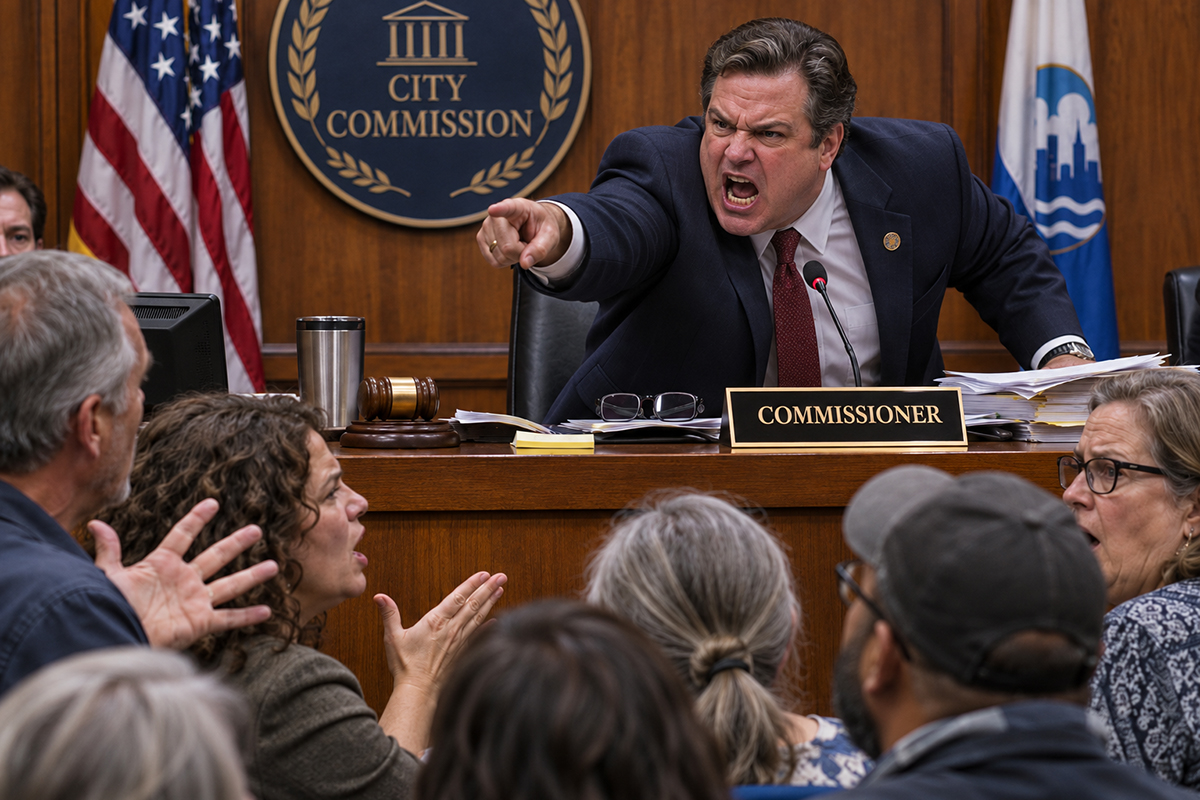
18 Nov When a Local Elected Commissioner Doesn’t Get Their Way, Everyone Pays
Political intimidation may generate attention, but research suggests it can also erode public trust, undermine employees, and create consequences that extend far beyond the commission dais.
There is a particular kind of behavior that occasionally shows up in local government, and it’s difficult to watch.
An elected official doesn’t get the answer they wanted. A colleague refuses to support their position. A city employee makes a recommendation they don’t like. A motion fails.
Suddenly, what should have been an ordinary disagreement becomes personal.
The voice gets louder. The accusations begin. Someone’s job is questioned. A threat is made about what might happen next.
And everyone in the room knows the conversation is no longer about the issue being discussed.
I’ve spent enough time around local government to recognize the difference between an elected official asking tough questions and someone trying to intimidate others into submission.
The first is part of the job. The second can become a serious problem for the entire municipality.
What makes it particularly troubling is that the people being threatened may be the very employees, colleagues, or community members who have spent years helping that elected official accomplish something.
Apparently, loyalty and cooperation are only appreciated until somebody says no.
The Dais Isn’t a Personal Throne
A city commissioner is one member of a governing body.
They have a vote. They can introduce proposals, question staff, debate policy, and challenge decisions. Depending on the municipality’s charter, they may also participate in hiring and evaluating senior officials.
Those are significant responsibilities.
But holding public office doesn’t mean everyone else has to agree with you.
In fact, the entire structure of a city commission assumes disagreement will happen. That’s why there are multiple elected members, public hearings, recorded votes, and established procedures.
A commissioner who loses a 4–1 vote hasn’t necessarily been mistreated. Their proposal simply didn’t receive enough support.
The response should be to reconsider the argument, build a coalition, or accept the decision.
Threatening people because the outcome wasn’t what you wanted is something else entirely.
And calling that behavior strong leadership doesn’t make it so.
What the Research Actually Says
There’s a temptation to assume that elected officials who routinely insult, threaten, or belittle others eventually destroy their political careers.
The evidence is more complicated.
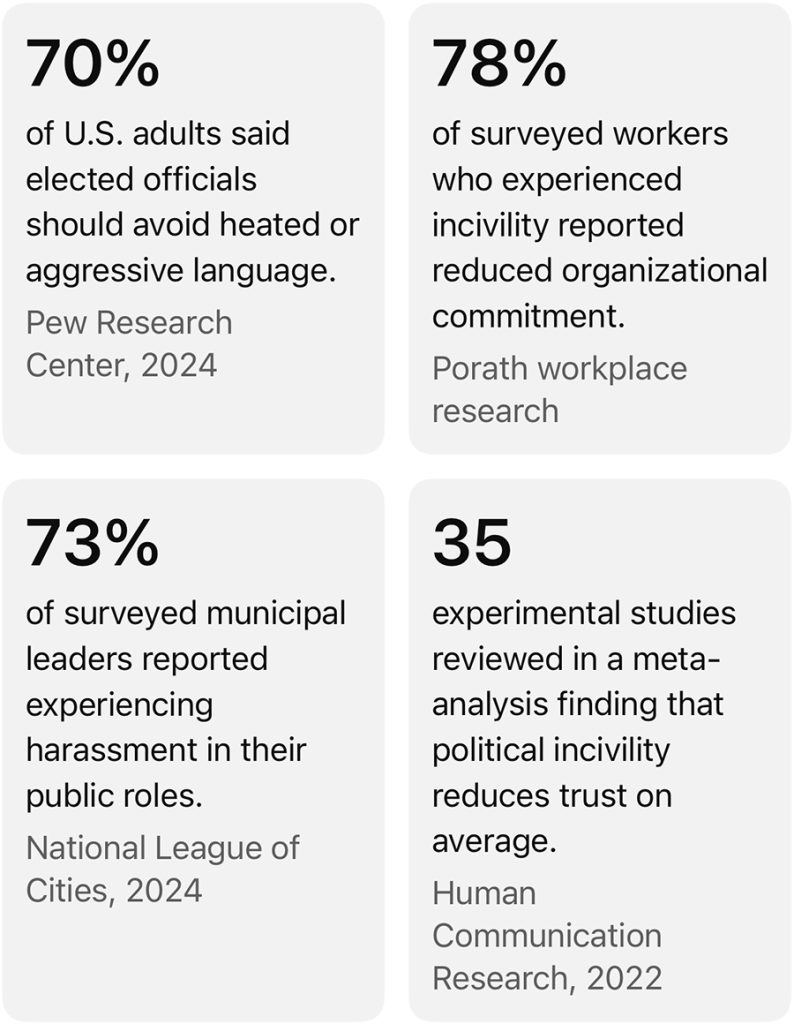
A 2024 Pew Research Center survey of 5,140 American adults found that 70% believed elected officials should avoid heated or aggressive language because it could encourage some people to take violent action.
That included 83% of Democrats and Democratic-leaning independents and 56% of Republicans and Republican-leaning independents.
That’s a substantial majority expressing concern about aggressive political rhetoric.
But disapproving of someone’s behavior and refusing to vote for them are two different things.
A 2021 study published in Research & Politics, involving 2,065 experimental participants, found that uncivil and intolerant political messaging produced negative emotional reactions and tended to harm rather than help candidate evaluations.
However, another study published in Political Psychology in 2024, using experiments in Switzerland and the United States, found that uncivil communication did not necessarily reduce the persuasiveness of a political message.
The lesson isn’t that every politician who behaves badly will lose their next election. Some voters may dislike the conduct, others may overlook it, and some may interpret confrontation as determination.
There is no credible universal statistic showing that elected officials who throw public tantrums have the lowest reelection rates.
But electoral survival is hardly the only measure of the damage.
The Real Damage Happens After the Meeting
Imagine working for a city where you know an elected official has a history of publicly attacking employees who deliver unwelcome information.
You have a report showing that a proposed project will cost more than expected.
Do you present the findings exactly as they are? Or do you spend additional time preparing for the political reaction?
You have a recommendation that contradicts something a commissioner promised publicly.
Do you offer your professional assessment? Or do you look for a way to soften the conclusion?
Nobody has to explicitly order employees to withhold information for a damaging workplace culture to develop.
People learn what happens when they disagree.
And they adjust.
That isn’t hypothetical organizational behavior.
Research summarized by Christine Porath in McKinsey Quarterly found that among nearly 800 managers and employees surveyed across 17 industries who experienced uncivil treatment:
- 66% reported that their performance declined.
- 78% said their commitment to the organization declined.
- 47% deliberately reduced the time they spent working.
- 38% deliberately reduced the quality of their work.
- 12% reported leaving their jobs because of uncivil treatment.
These are workplace findings, not a study specifically of city commissioners. They don’t prove that every confrontational elected official produces the same outcomes.
But the organizational risk is clear.
A city needs experienced employees willing to provide accurate information, including information elected officials may not want to hear.
When people become afraid of delivering bad news, the quality of government decisions can suffer.
Taxpayers Don’t Get a Discount for Dysfunction
Consider how much time and money can be consumed by a personal political dispute.
A department director spends hours preparing responses to accusations that could have been resolved through an ordinary conversation.
The city attorney reviews correspondence, researches procedural questions, or responds to allegations.
Projects are delayed while staff navigate conflicts between elected officials.
Employees who no longer want to work in that environment begin looking elsewhere.
Replacing experienced municipal personnel isn’t free. Neither are legal reviews, recruitment, additional meetings, or the institutional knowledge that disappears when someone leaves.
Not every disagreement produces these costs. Vigorous oversight is necessary, and legitimate allegations of misconduct deserve investigation.
The problem arises when the machinery of government is used to pursue personal retaliation rather than a legitimate public purpose.
Residents aren’t paying taxes to finance someone’s grudge.
They’re paying for services.
Roads. Drainage. Public safety. Parks. Permitting. Infrastructure.
Every hour devoted to managing unnecessary political conflict is an hour unavailable for something else.
What Does This Do to Public Trust?
Political behavior doesn’t occur in a vacuum.
Residents watch commission meetings. Employees talk to one another. Business owners observe how disputes are handled. Community volunteers decide whether participating is worth the trouble.
A systematic review and meta-analysis published in Human Communication Research examined 35 experimental studies of political incivility.
The researchers found a statistically significant, though relatively small, negative effect on political trust, with an average effect size of Hedges’ g = −0.19.
The effect was stronger in experiments using video than in those using other forms of communication.
The study did not find a meaningful average effect on political participation, so it would be inaccurate to claim that incivility universally causes people to disengage.
That distinction matters.
A public confrontation may generate attention. It may even motivate some residents to become more politically active.
But increased attention doesn’t necessarily mean increased confidence in government.
And there’s something particularly damaging about residents watching elected officials use public meetings to pursue personal disputes while routine municipal business waits.
When Political Conflict Becomes an Economic Development Problem
Cities compete for businesses, investment, redevelopment, and experienced employees.
Companies evaluating a location consider many factors: demographics, workforce, taxes, transportation, infrastructure, and the cost of doing business.
The predictability of local government matters, too.
A business owner can plan around a clearly written ordinance. A developer can evaluate the financial implications of a published fee schedule. An investor can account for a defined approval process.
Personalized threats and unpredictable political interference are much harder to incorporate into a business plan.
That doesn’t mean a commissioner should approve every development or avoid challenging a business proposal.
Quite the opposite. Consistent, evidence-based scrutiny can make a city’s decision-making more credible.
But there is a difference between applying demanding standards and making people worry that an official disagreement will become a personal vendetta.
A city can spend years building a reputation for professionalism and predictability.
Its public meetings are one place where that reputation is either reinforced or questioned.
The People Who Enable the Behavior
One of the more uncomfortable aspects of this problem is how organizations adapt to it.
People start warning newcomers about which subjects might trigger an outburst.
Staff prepare differently for certain commissioners.
Colleagues avoid raising issues because they know the discussion will become personal.
Eventually, everyone becomes so accustomed to the behavior that an ordinary, respectful disagreement feels like an accomplishment.
That’s not a healthy organizational standard.
And it raises a question for the other elected officials.
When a colleague makes an inappropriate personal threat, do they respond through the procedures available to the commission? Do they insist that staff be treated professionally? Do they distinguish legitimate criticism from retaliation?
Or does everyone decide that accommodating the behavior is easier than addressing it?
Avoiding a confrontation may solve the immediate problem while leaving the underlying pattern intact.
Political Ambition and the Limits of Intimidation
There is another distinction worth making between winning an election and building a political career.
A candidate can win a local race because voters support a particular policy position, recognize their name, dislike the opposition, or approve of their record.
Those factors may outweigh concerns about personal conduct.
But serving effectively in government also involves persuading colleagues, working with staff, understanding complicated issues, and maintaining relationships with people who disagree.
A commissioner can win an election without winning every argument afterward.
And no matter how popular an elected official may be, one vote still counts as one vote on a five-member commission.
A person who repeatedly turns disagreements into personal confrontations may make coalition-building more difficult. That’s a practical institutional concern, not a proven prediction about that person’s next election.
Political influence isn’t measured only by how loudly someone can demand an outcome.
It’s also reflected in whether other people can work with them to accomplish something.
The Problem Is Bigger Than One Personality
The National League of Cities surveyed 256 mayors, city council members, and city managers in 2024.
73% reported personally experiencing harassment connected to their public roles.
Among those who experienced harassment, 84% reported harassment during public city meetings, compared with 64% in the organization’s 2021 survey.
Those numbers describe harassment experienced by municipal leaders, not specifically misconduct committed by elected officials. The distinction is important.
Still, they illustrate how hostile the environment surrounding local government can become.
The solution isn’t to eliminate disagreement or demand that everyone behave as though they’re attending a polite dinner party.
Government should involve serious arguments. Commissioners should challenge questionable spending, expose legitimate problems, and insist on accountability.
Residents should be able to express frustration, too.
But disagreement and intimidation are not interchangeable.
Neither are accountability and revenge.
Public Office Doesn’t Entitle Anyone to Get Their Way
One of the basic realities of representative government is that nobody gets everything they want.
Not the mayor. Not a commissioner. Not a developer. Not a resident. Not even someone who has spent years supporting a particular elected official.
The system is designed around competing priorities, limited resources, and decisions that require support from more than one person.
That can be frustrating.
It’s supposed to be.
The alternative would be giving individual officials the power to impose their preferences without meaningful disagreement.
When a commissioner responds to opposition by threatening people, publicly humiliating them, or using official authority to pursue a personal grievance, the concern goes beyond the unpleasantness of the confrontation.
It raises questions about how decisions are being made, whether employees can exercise independent judgment, and whether public resources are being used for legitimate purposes.
And residents deserve to understand those consequences.
A city commission meeting shouldn’t become a place where everyone spends the evening calculating how to avoid making one person angry.
The purpose of the meeting is to conduct the public’s business.
Losing a vote is part of democracy. Turning that loss into a campaign of personal retaliation is a problem democracy shouldn’t have to accommodate.
Sorry, the comment form is closed at this time.